Why Music Composition for Ads Demands a Different Creative Muscle
@mymusiccompositionadspost
I spent years writing songs for bands, albums, and the occasional film score before I ever sat down to write a thirty-second spot for a car brand. The first time I opened a session in Logic Pro and saw a timeline measured in seconds rather than minutes, I felt a strange mix of relief and panic. Thirty seconds is not a limitation. It is a different kind of canvas. And that is the first lesson anyone learns when they step into music composition for ads: you have to say everything in half the time you think you need.
Commercial music has its own set of rules. In a pop song you can spend a full minute building a verse-chorus dynamic. In an ad you often have to establish mood, support a narrative, and leave a sonic fingerprint in the time it takes to boil an egg. That compression is not a flaw. It is the craft. And over the years I have watched talented composers from Hollywood and Los Angeles struggle with this shift because they treated it like a shorter version of something else. It is not. Music composition for ads is its own discipline, with its own vocabulary, its own workflow, and its own relationship to sound design and voiceover.
Time Is the Real Instrument
When you work in a DAW like Pro Tools or Ableton Live, you can zoom in to the sample level and finesse a single transient. That level of control is essential in ad work because every frame matters. A spot that runs fifteen seconds in length might have three distinct emotional beats. The music has to hit each one without sounding rushed or mechanical. That means you cannot rely on the slow build of a synth pad or the gradual bloom of a reverb tail. You have to front-load the emotional information.
I once worked on a spot for a travel brand where the brief asked for "wonder and urgency" in twelve seconds. The director wanted the viewer to feel the excitement of a last-minute trip and then the calm of arrival. We ended up using a simple piano motif that started in an unexpected key, then resolved into a warm major chord just as the voiceover said the brand name. That resolution took maybe a second and a half. In a song that moment would be a chorus payoff. In an ad it is the entire arc. That is the kind of compression that makes music composition for ads a unique creative challenge.
The Marriage of Music and Sound Design
One of the biggest mistakes I see from composers who are new to commercial work is treating music and sound design as separate layers that happen to play at the same time. In the best spots they are fused. A Foley element like a footstep or a car door closing can be pitched and timed to function as a percussive hit. A synth pad can be shaped to feel like a wind effect or a mechanical hum. The line between score and sound effect is deliberately blurred.

This is where tools like Ableton Live shine because they let you route audio in creative ways. I have taken a recording of a coffee mug being set on a table, processed it through a granular synth, and used it as a rhythmic element under a voiceover. That kind of integration is hard to pull off if you treat the audio engineer and the composer as separate roles. In a good post-production studio the mix engineer and the composer are often the same person, or at least they are in the same room, and that changes everything.
Voiceover and Musical Timing
A voiceover track is not just narration. It is a rhythmic anchor. When a voice hits a certain syllable, the music has to be ready for it. I have spent hours nudging a single kick drum hit by a few milliseconds so it lands exactly on the "t" of a word like "commitment." That level of precision is normal in this world. And it is one reason why working in a DAW like Pro Tools, which was built for picture editing, can be more practical than a pure music DAW. Many composers I know keep both Logic Pro and Pro Tools open during a session, bouncing audio between them for different tasks.
I remember a session where the voiceover artist delivered a line with a slight pause that the director loved. The problem was that pause fell right where I had written a descending bass line. I had two choices: rewrite the bass line or let the music fight the voice. I rewrote it. The voice always wins in commercial work. That is a hard lesson for composers who come from the album world, where the vocal is just one element among many. In an ad the voiceover carries the message, and the music has to support it without competing.
Brand Identity and Musical Shortcuts
Every brand has a sonic fingerprint, whether they have formalized it or not. A luxury car brand signals a different set of values than a fast-food chain. A children’s toy company uses a different harmonic language than a financial services firm. When you are asked to write music for a brand, you are not just writing a nice piece of music. You are reinforcing a brand identity. That means making choices about instrumentation, tempo, key, and even the density of the arrangement based on what the brand stands for.
I once had a brief that asked for "confident but not aggressive." That is a subjective description, but it translates to specific musical decisions. Confident means a steady tempo, a strong downbeat, and a clear harmonic center. Not aggressive means avoiding distorted guitars, avoiding loud percussion hits, and keeping the dynamic range narrow. The result was a track built around a clean electric piano, a simple bass line, and a brushed snare. It sounded nothing like what I listen to on Spotify in my free time, but it was exactly right for the brand.
The Licensing Trap
Many production companies try to save money by using royalty-free music from libraries. I have nothing against a good library track. Some of them are well-produced and perfectly functional. But they are generic by design. A royalty-free track cannot respond to a specific edit or a specific voiceover performance. It cannot change its arrangement when the director decides to extend a shot by two seconds. And it cannot carry the subtle emotional tailoring that a custom composition provides.
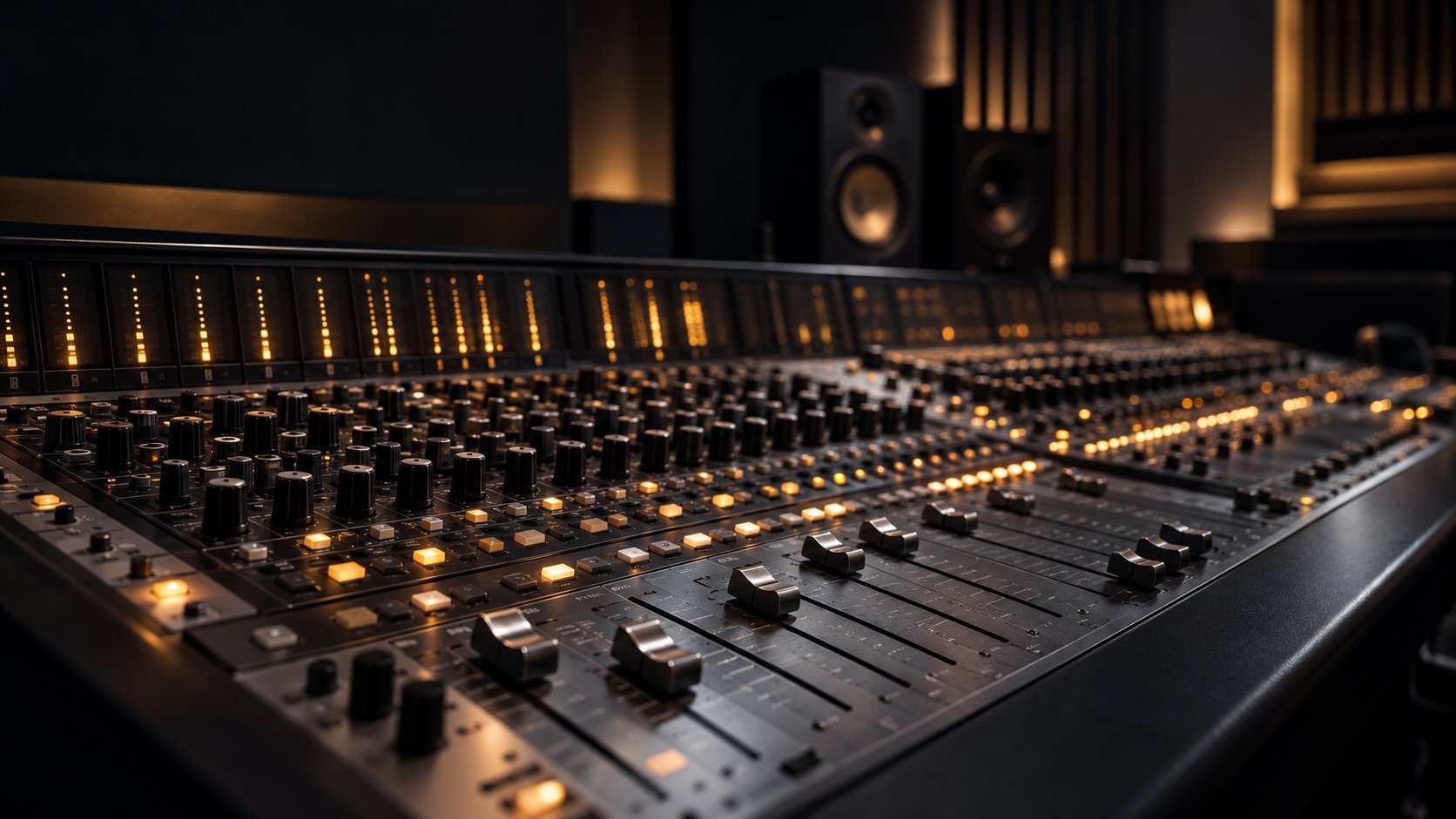
Custom music composition for ads is expensive because it solves a problem that stock music cannot touch: it makes the edit feel inevitable. When the music and the picture are composed together, the viewer does not notice the join. They just feel the emotion. That seamlessness is the value of custom work, and it is why brands with strong identity invest in original composition rather than licensing a track off a library.
Tools of the Trade
The technical side of ad composition has its own preferences. Pro Tools remains the standard for picture-locked sessions because of its video engine and its timeline workflow. Logic Pro is popular for its MIDI handling and its stock instruments. Ableton Live is the go-to for sound design and loop-based experimentation. Many composers use all three, bouncing stems between them. I know mix engineers who refuse to accept anything other than a Pro Tools session, and I know others who are happy to work with audio stems exported from any DAW.
Microphone choice matters too, especially when you are recording Foley or custom sound effects. A good condenser microphone can capture the texture of a fabric rustle or the click of a button, and those sounds can become part of the musical fabric. I have recorded the sound of a zipper and used it as a snare replacement in a track for a clothing brand. That kind of creative thinking is common in this field, and it is one of the reasons I find commercial work more satisfying than pure songwriting.
Working with Directors and Editors
If you have ever tried to sync music to a Final Cut Pro timeline that keeps changing, you know the frustration. Picture edits shift, scenes get trimmed, and the music has to follow. A good composer builds flexibility into the arrangement from the start. That might mean keeping the percussion sparse so it can be moved, or writing the melody in a way that allows for loop points and alternate endings. You learn to think in versions, not final masters.
I once delivered a spot with seventeen alternate mixes. Some were just a few seconds shorter. Others had different endings. One had the drums removed entirely because the director decided the spot needed to feel more intimate. I kept every version, labeled clearly, and let the editor test them against the picture. In the end the version they used was the one I had written first, but I could not have known that at the start. The process is iterative, and patience is part of the skill set.
The Decline of the Advertising Jingle
The old advertising jingle, a short catchy song built around a product name, has mostly disappeared from mainstream commercials. What replaced it is more subtle. Modern commercial music often avoids lyrics altogether, or uses vocal phrases as texture rather than as a hook. The reason is that viewers are more sophisticated now. A jingle that repeats a brand name feels manipulative. A piece of music that evokes a mood without shouting the message feels authentic.

That shift has made the composer’s role more important and more difficult. You have to communicate brand identity without lyrics. You have to build recognition without repetition. And you have to do it in a way that survives the skip button and the mute icon. That is a high bar, and it is why the best commercial composers are also skilled sound designers and arrangers. They understand that every element of the audio track, from the voiceover to the Foley to the synth pad, is part of the same musical statement.
Writing music for ads is not a stepping stone to something else. It is a demanding, rewarding craft that requires its own training, its own tools, and its own instincts. The composers who do it well treat it with the same seriousness as any other musical discipline. And the best ones never stop learning how to say more with less.